


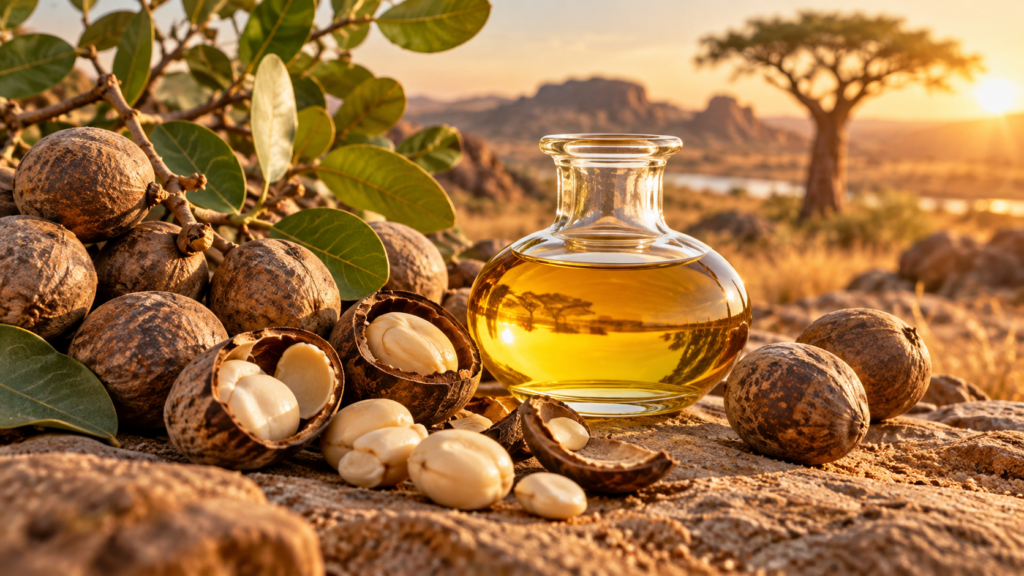
Manketti oil, extracted from the kernels of Schinziophyton rautanenii, also known as the Manketti, mongongo or mungongo tree, it is found across parts of Southern Africa, including Namibia, Botswana, Zambia and Zimbabwe. The hard-shelled nuts have long been valued as food, and the kernels provide oil with a distinctive fatty-acid profile and naturally occurring tocopherols. As with any botanical ingredient, the final oil’s properties depend on how the nuts are handled, processed and stored.
A Tree Rooted in Southern African Landscapes
Manketti is adapted to dry, sandy landscapes, including areas associated with Kalahari sands. Its nuts and fruit have food uses, and the kernels are processed for oil after the hard shell is removed. Because traditional and modern methods differ, manufacturers should ask suppliers how the oil was produced and what tests were carried out on the batch.
A Fatty-Acid Profile That Sets Manketti Apart
Manketti oil is notable for its combination of linoleic acid and alpha-eleostearic acid. Linoleic acid is an omega-6 polyunsaturated fatty acid found in many plant oils and is valued in cosmetics for its emollient role, helping soften the skin and improve its feel. Manketti is distinctive because it also contains alpha-eleostearic acid, a conjugated fatty acid less commonly discussed in everyday cosmetic oils.
A 2018 study of Manketti oil from Namibia reported alpha-eleostearic acid at approximately 24–36% and linoleic acid at 31–32% of the fatty-acid profile in the samples analysed. These figures help explain the oil’s scientific interest, but they are not a specification for every commercial batch. Growing conditions, kernel handling and extraction can influence composition, so formulators should request batch-specific fatty-acid data.
Alpha-eleostearic acid is important because its structure differs from that of the more familiar linoleic and oleic acids. It has three double bonds arranged in a conjugated pattern, meaning the bonds are separated by one single bond rather than being spaced in the usual way. This structural feature gives the oil a distinctive chemical profile and makes it relevant to research on drying and oxidative behaviour. It does not, by itself, prove a particular skincare benefit. For cosmetic formulators, the practical value lies in recognising that Manketti is not simply interchangeable with a more conventional oil: its composition may affect how it behaves in a blend, responds to processing and needs to be assessed for stability.
Tocopherols: Natural Antioxidants
Manketti oil also contains tocopherols, a family of compounds that includes forms of vitamin E. In the Namibian study, total tocopherol content varied from approximately 144 to 206 milligrams per 100 grams of oil, with gamma-tocopherol identified as the dominant form. Tocopherols can help slow oxidation by reacting with free radicals, which is one reason they are of interest in oils used for food and cosmetic applications. Their presence adds to the oil’s distinctive composition, but it should not be confused with a guarantee that the oil or a finished cosmetic formula will remain stable indefinitely.
Extraction and handling can influence how much tocopherol remains in the oil. Heat, air, light and storage time may affect quality before the ingredient reaches the formulator. Published research explains the oil’s potential but cannot replace batch-specific documentation from the supplier, particularly when a formula depends on a consistent composition.
Oxidative Stability
Oxidative stability describes how well an oil resists reacting with oxygen. Oxidation can change odour, colour and other quality characteristics. An oil’s behaviour depends on its fatty-acid profile, natural antioxidants, processing history, temperature, exposure to air and light, and packaging.
Manketti’s naturally occurring tocopherols may contribute some protection against oxidation, while its high level of unsaturated fatty acids means stability still deserves attention. The conjugated structure of alpha-eleostearic acid makes Manketti chemically unusual, but it would be misleading to describe the oil as automatically more stable than other plant oils on the basis of composition alone. The published characterisation study reported peroxide values for the samples tested, which provide an indication of primary oxidation at the time of analysis; they do not establish a universal shelf life for all Manketti oil or prove how a particular formula will age.
Formulators should assess the oil in the context of its intended use: review supplier specifications, check odour and appearance on receipt, protect it from excess heat, light and air, and test the finished product in its intended packaging. An antioxidant may be appropriate, but it cannot replace good raw-material handling or stability testing. A facial oil and an oil incorporated into an emulsion may present different stability challenges.
Extraction Methods Can Change the Oil
Extraction method is an important part of Manketti oil’s quality story. Research has compared cold-pressed, traditionally extracted and Soxhlet-extracted oil; Soxhlet is a laboratory method that uses a solvent to draw oil from prepared kernels. These methods serve different purposes: mechanical pressing is relevant to commercial production, while solvent extraction can help researchers compare composition and oil yield.
Cold pressing may appeal to brands seeking oil produced without solvent extraction, but “cold-pressed” alone does not prove that an oil is superior in every respect. Kernel quality, hygiene, filtration, storage and the details of the pressing process also affect the finished material. Traditional methods may involve heat, so suppliers should explain the actual process. Studies comparing cold-pressed, traditional and solvent-extracted samples have found differences in yield, physicochemical measures and tocopherol content.
Formulators should request the extraction method, batch identification, fatty-acid profile and relevant quality parameters. Depending on the intended product, further documentation may cover contaminants, microbiological quality, traceability and shelf life.
Manketti Oil in Modern Skincare
Manketti oil may be explored in facial and body oils, creams, lotions and balms as a plant-derived emollient. Used alone or blended with other oils, it can help shape texture and skin feel. The suitable level depends on the complete formula’s performance, stability and sensory profile.
It may be considered for products aimed at dry or rough-feeling skin, since emollients help soften the skin’s surface. The result depends on the whole formula, including its oils, humectants and emulsifiers. Manketti oil should not be presented as a stand-alone treatment for a skin condition or a guaranteed solution to dryness.
A Place in Haircare
Plant oils are used in conditioners, masks, serums and leave-in products to improve slip, softness and manageability. Manketti oil could be explored in products for curly, coily or textured hair, but research has focused mainly on its chemical composition; there is not enough evidence to claim that it promotes hair growth or treats scalp conditions.
Quality, Storage and Responsible Sourcing
For cosmetic manufacturers, reliable sourcing means being able to identify the botanical species, explain the origin and extraction method, and provide batch-specific documentation. Relevant information may include appearance, odour, fatty-acid profile, acid and peroxide values, storage recommendations and shelf life. Manketti oil should be protected from excess heat, light and prolonged exposure to air, while stability testing should assess the finished product in its intended packaging.
Responsible sourcing matters too. Where local communities collect, process or trade Manketti nuts, dependable partnerships and fair purchasing practices can help share commercial value. Sustainability claims should reflect actual harvesting practices, habitat considerations and supplier documentation, not simply the ingredient’s African origin.
An African Ingredient with Room to Grow
Manketti oil connects Southern African landscapes and traditional uses with research into a distinctive composition. Its linoleic acid, alpha-eleostearic acid and tocopherols give formulators reasons to explore it, while underlining the need to assess each batch’s quality and oxidative behaviour. It may offer a distinctive option for skincare and haircare concepts built around emollience, sensory experience and documented origin.
The strongest product concepts will combine a well-characterised oil, a clear formulation purpose, suitable quality controls and honest communication, while respecting the communities and landscapes connected to it.
References
1. Cheikhyoussef, N., Kandawa-Schulz, M., Böck, R., de Koning, C., Cheikhyoussef, A., & Hussein, A. A. (2018). Characterization of Schinziophyton rautanenii (Manketti) nut oil from Namibia rich in conjugated fatty acids and tocopherol. Journal of Food Composition and Analysis, 66, 152–159.
2. Gwatidzo, L., Botha, B. M., & McCrindle, R. I. (2017). Influence of extraction method on yield, physicochemical properties and tocopherol content of Manketti (Schinziophyton rautanenii) nut oil. Journal of the American Oil Chemists’ Society, 94, 973–980. 3. Vermaak, I., Kamatou, G. P. P., Komane-Mofokeng, B., Viljoen, A. M., & Beckett, K. (2011). African seed oils of commercial importance—Cosmetic applications. South African Journal of Botany, 77(4), 920–933.